Pages

Sunday, 26 March 2017

Survey, Tally and Graph

Kids can be taught about organizing data, analysis, and presentation through a simple survey activity. Children learn best when they move around and collect data. After collecting the data, they learn to present the data through a simple graph.  These hands on graphing practice will help them to read graphs and tables at more advanced levels later.

We did two surveys this week.  The first day, my daughter and I stood in our balcony and recorded the traffic data for 10 minutes. I helped my little one to draw the tally marks to 5 and also to draw the bar graph for her data. The first bar graph was not to scale as shown here. The main idea here is to show how the graph represents the data.


The next day, she was given with another project – Tree survey. She recorded the count of our backyard trees.


Then I gave her a graph sheet (hand drawn) and asked her to draw the bar graph.  We also had an analysis session like “10 more than, equal to, 5 less than, 2 more than,etc".

Sunday, 19 March 2017

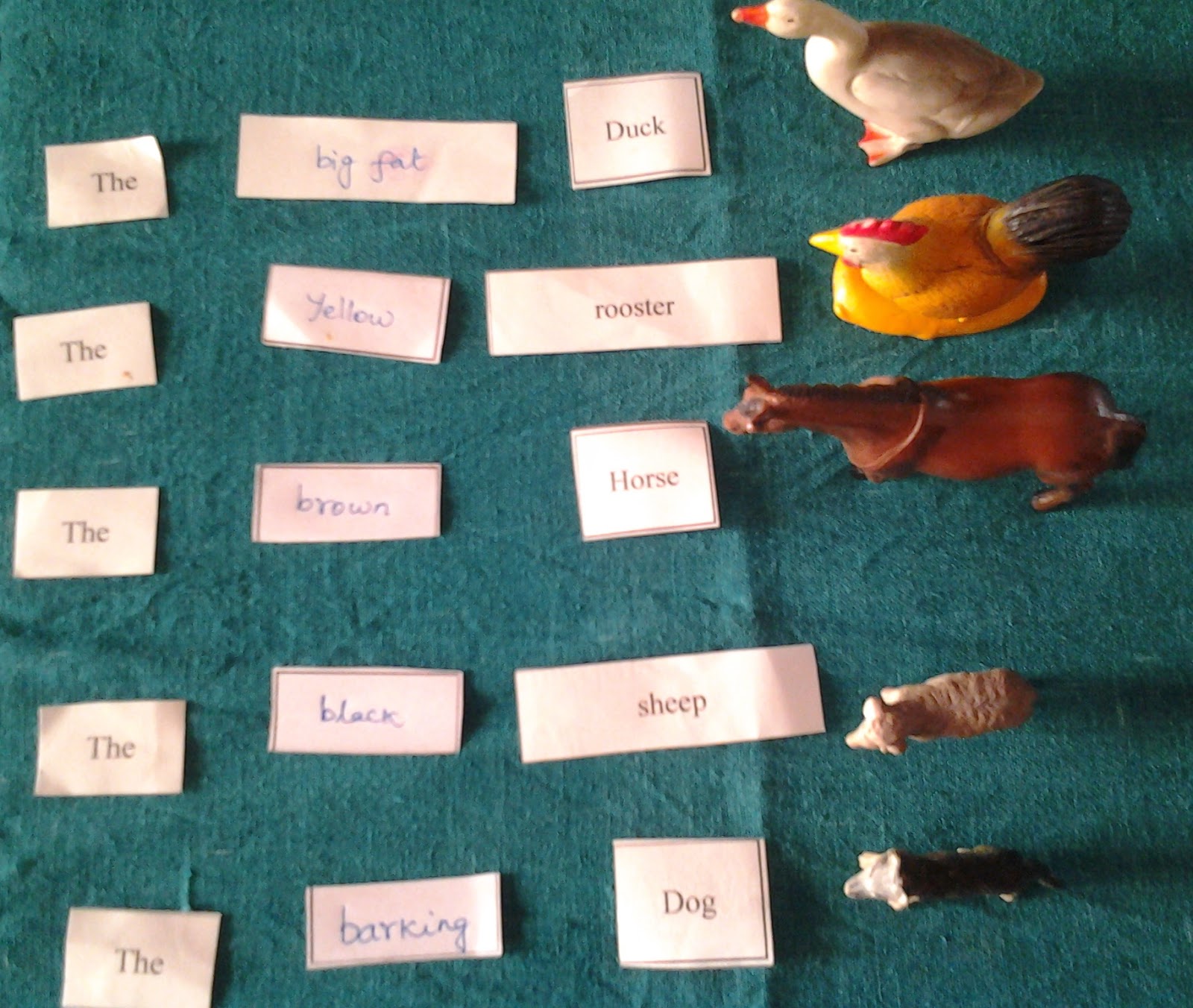
The First Grammar Lesson with Montessori Grammar Farm

We have been on grammar study and I am very much thrilled to share our first grammar activities.  Montessori grammar is the best way to introduce grammar to young kids as it is taught in sensorial way.  There are many Montessori grammar activities – The farm game-grammar symbols for introducing the parts of sentence and grammar boxes - grammar cards for practice and analysis.

It’s best to introduce grammar after 6 or when the child has become a fluent reader.  My little one is 7+ and she is good at reading and writing. So, this is the time to introduce grammar.  In the first grammar week – we studied about articles, adjectives, and noun.

 When I started making our grammar farm, my littleone was curious and started asking me what it is.  When I told her about the grammar farm, she wanted to see some images in google. (Whenever she heard about something new, she used to see the related images in google).  “Wow, these are all beautiful. Amma, ours should be equally good. Ok?”


We began with a play.  I started telling,
“Go to the kitchen.”
“Go to the hall. “
“Take a pencil.”
“Bring me a Plate.”
“Go and touch your Dad.”
My little one happily ran here and there to follow what I said.
When I said, “Bring me------.” 
                       “Touch ---.”
                      “Go to ------.”  
She was confused, laughed and started asking me ‘what’, ‘where’ and ‘whom’.
            “So, I need to say the names of persons, objects and places.  Don’t I? In grammar, these names are              called nouns.”

Then, I arranged the grammar farm and asked her to name whatever she found in our farm.


Then I introduced the ‘article’ which will always be associated with the noun – ‘an’, ‘a’, or ‘the’.
“Use ‘a ‘or ‘an’ to choose one among many and ‘the’ when there is only one.”  (I purposefully replaced the tractor by a bullock cart)


Then, we added adjectives to give more details to the noun.
 “Which rooster you like?”
“This one.”
“Which rooster?”
“This yellow rooster – the big Rooster.”
“Good.  That is adjective. Let us add some details to the noun to identify them easily.”

We are going to continue our grammar work and I will share it soon.

Monday, 13 March 2017

Interactive Science Notebook

The interactive science notebook (ISN) is an essential tool in elementary in which a student can record what (s)he observes in the class (or in the nature walk). Interactive notebooks support drawing, writing, and creativity among young children. It also improves the organization skill. We began our ISN recently and here are some glimpses of how it looks.


I like her leaf shaped 'P' in 'Plants'


Tuesday, 7 March 2017

DIY Foam Pattern Blocks

Pattern blocks are the favorite math manipulative of every child. It helps to teach kids about shapes, patterns, fractions, Tessellations, and much more.  Moreover, it engages children for hours as a quite time activity.

Generally, pattern blocks are made out of plastic or wood. But, I made my pattern blocks using foam. All I needed were the templates, craft foam sheets and a pair of scissors.  It is very simple, cheap, and won’t make any noise while playing. Real pattern blocks come in standard colors – triangle-green, square-orange, rhombus-blue, thin rhombus-tan, trapezoid-red, and hexagon-yellow. As I didn’t have blue and tan, I used violet for rhombus and pink for thin rhombus.


You can download the pattern blocks templates from here and templates of pattern block mats from here

Here are some of the photos of my daughter’s creations.


RABBIT

 CAMEL

BABY

 GIRL
 
DOG

We both made few tessellations..


Monday, 22 August 2016

Comic By Janani

Today I wanted to share a comic my little one created. In our childhood, my brother had a huge collection of ‘Rani comics’ and we would be fighting for it. Now, my little one has only two comic books in our story book collection but, wanted to make one on her own. 

She loves drawing and she wanted to make the comic based on a story that I narrated.  It was ‘Long Bony Finger’ by Gargi pant and you can read the story here.


This is what she made. I loved the way she created the characters and planned the frames. 


I read Mickael Corley's post on making comic strips and I loved it. So, I wanted to convert my little one’s work into comic strips. First, I began to ink her drawings and dialogues. When I started doing this, my little one’s enthusiasm grown and she included and redrew few more scenes. I created the border template in the strips, cut the frames from her comic and paste it in the template.  


My husband made this soft bound and labeled it. Her first comic is all ready!


Sunday, 7 August 2016

Fall in Love with Tie and Dye

It is all started in one fine evening - we tie-dyed some white fabrics and we had lot of great time together. It’s fun, easy, and the final outcome is fantabulous.   We started with acrylic paints and continued with artificial colors and natural colors.


Whatever is the dye - whether it is acrylic paints, natural colors or artificial colors, the first step is to prepare the fabric.  I cut an unused Dhoti into small squares and folded them.  Actually, creating different patterns depends on how the fabric is being folded. For different folding techniques check here.We can make stripes, bold concentric circles, spirals or something new. Yes, you don’t need to worry about the final pattern. However you fold, you’ll create something new, unique, and colorful patterns.  Excitement guaranteed.  

To Tie and dye with Acrylic paint:

1.      Fold the fabric according to your preference and tie it up using rubber bands or knots as shown. Wet the cloth and dilute the acrylic paints. The paint can be applied using a brush as we did or you can fill diluted paint in a squeeze bottle and apply it.  Let them set at least for half an hour and then remove the knots/rubber bands. Now you can wash the fabric and dry it.

                                                                           For Spiral Shapes


2.      This is acrylic paints sun prints.  Wet the fabric, paint it and place leaves, flowers or foam shapes, keys or stencils as shown and dry it completely in sun light. Kids will be surprised when they pull of the shapes.


To tie dye with natural colors:

I wanted to try some natural colors and I used turmeric power - definitely a foolproof one. Put a table spoon of turmeric powder and a tsp of salt in boiling water. Put the folded and tied fabric and switch off the flame.  Let it sit for couple of minutes and then wash the cloth and dry it.


I also boiled some onion skin and pink radish skin.  I used unfolded white cloths as  I just wanted to see the color it brings.  These are the results.


To tie dye with artificial colors:

Just like turmeric powder add a tbsp of dye powder and salt in the boiling water and then pour it on the tied fabric.  Let it sit for couple of minutes and then wash the cloth and dry it.


Acrylic tie dye is best for kids under 7 as the other 2 methods need boiling water. Tie dye is the craft that will never get old. Creating the unique patterns and colorful deigns is easy and I am sure your kids will enjoy a lot.