Pages

Friday, 27 June 2014

Our Vertebrate - Invertebrate Unit

Our study on invertebrates starts when I hit a cockroach.  I called my little one, showed her  and told that it does not have a backbone and it’s an invertebrate.

But my little one felt sorry for the cockroach and asked me why I hit it.
“It would be paining” she added.
“No, it won’t. It lacks a nervous system and invertebrates cannot feel the pain.”

I had a lizard skeleton which I preserved a long ago for our vertebrate unit.  I also had a fish skeleton. I brought it and we had a closer look using our magnifier.


I set our vertebrate tray with a paper human skeleton, a plastic Dinosaur skeleton and the skeletons of fish and lizard.

Watch this wonderful video by Arvind Gupta to make a simple paper skeleton.


For a sorting practice, I gave her a handful of toys from our miniature unit.  She went inside, took the entire miniature unit and started sorting it.

But,  soon she started playing with her whale and shark.


Sunday, 15 June 2014

A Diorama of Sources of Water

It’s been my little one’s long time wish to visit a waterfall.  Her wish fulfilled recently. We visited 'kutralam' one of the famous waterfalls in Tamilnadu, India .  Though it’s not the season time and there was only a little water, she had a very nice time there. She even had a bath in the water falls. She and her dad stood under the cold herbal water for a long.  When she returned from the waterfalls, she was really icy cold. 


We used to visit the beaches, lakes, river and pond now and then.  So, I thought of making  a diorama of sources of water with my little one(Similar to land form models).


 I set the model of waterfall, river, pond, lake, well and tube wells in a cardboard box. I used agar agar strips for the waterfalls and small plastic boxes for pond and Lake. We also added few toys to represent the life in pond, lake and the riverside.


It really helped her to understand the source and destination of a river (Destination -Ocean is not included in the diorama as we thought of doing a separate study).


 We also visited our farmland to see the bore well.


We also watched this video

See our experiment on water cycle and sensory play on pond life

Tuesday, 13 May 2014

Rowing our Favorite Stories 2: The Little Red Hen

Here is my second post on FIAR (Five In A Row). 

We rowed the story “The little red Hen” which is again not in the actual FIAR curriculum.


It’s the story of a hen who worked hard to plant, grow and harvest wheat while her friends, the cow, the dog and the pig were lazy and not ready to help her. But, after baking the breads, she asks them who will help her  to eat the breads.  All the three happily volunteer.  But, the little red hen declines it. The story teaches about helping and cooperation in doing a work. Those who do not contribute cannot enjoy the result.

You can download the pdf of the story here.
Here is how we rowed the story.

Literature:

`My little one knows the phonics sound and she has just started to connect sounds to make simple words.  So, I asked her to write the words like hen, cow, pig and dog. 
I also asked her to point out the sight words I dictate.
We sang the rhyme ‘Old McDonald had a form’

Math:

I thought of introducing fractions to my little one. We made some sand breads  (Sand buns????)  and i asked her to cut them  into pieces to see the fractions like ½, 1/4, 1/5 and 1/8. She shared the pieces with her friends and they pretended eating it.


Art & Craft:

My little one drew this little red hen.


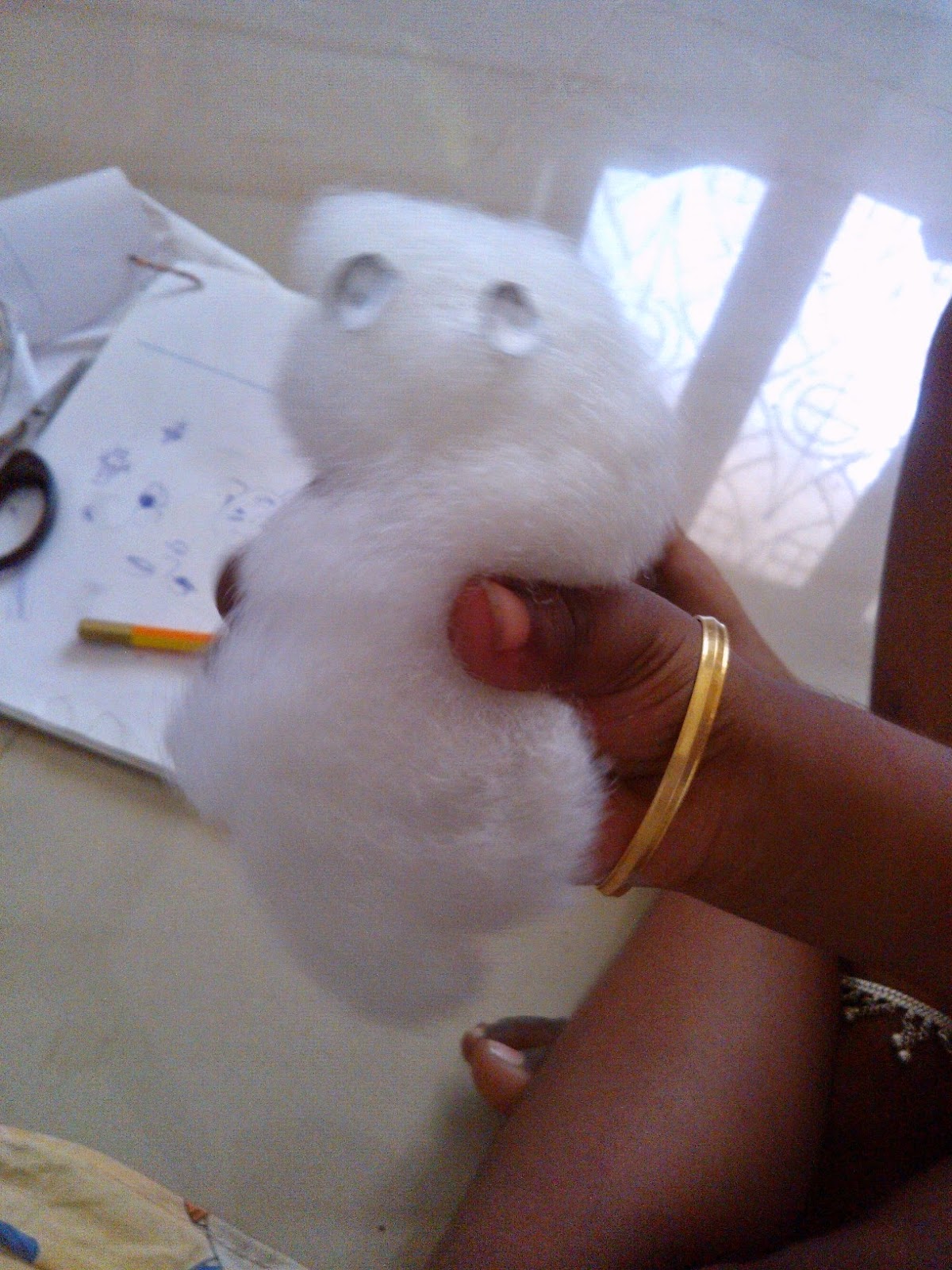
She also made this cotton chicken with my help.


Here is our paper little red hen. You can find the tutorial at krokotak.com


Science:

When we are reading the story, my little one asked what a mill is. So, i wanted to show her how a basic grist mill works.
First, we spend some time in our traditional stone mills.  We tried to make rice flour in our stone mill. 


My little one tried to rotate it.  She couldn't.  She found this from her wooden toy set and played with it.


 We also see how the mortar and pestle is used to grind the wet grains.
We watched these videos (video 1 , Video 2) which show how the same principle is used in the old flour mills.

Social Studies:

As Madhya Pradesh is the highest wheat producing state in India, we located the state in our India map.

Small World Play:

I thought of including a small world of farm animals as the sixth activity for my little one to play. Here is our small world of farm animals.  I wanted to put farm animals and foods what they eat. I put rice straws for cows, grass for goats and sheep , grass and horse gram for horses and some cereals for poultry.

My little one feed the horses with cereals i put for the poultry and started giving them bath.


Wednesday, 23 April 2014

FIAR: Rowing Our Favorite Stories - Ugly Duckling

First of all, what is FIAR? I came to know about Five In A Row(FIAR) here.  It is a detailed review on FIAR. The original FIAR curriculum has given a list of books and one has to choose a book from the list and read it with the child for five consecutive days. While reading the book, you have to do activities on literature, art, math, science and social studies one per day.  This is called rowing a story. The rowing is an interesting opening for many topics. You can find the list of FIAR books here.

 I haven’t yet bought the curriculum.  But I started collecting the stories as could as possible.

People who work on five in a row curriculum may wonder when they see the title.  Ugly duckling is not in the FIAR books list.

The idea of rowing a story is excellent.  Isn’t it? So, I started rowing some of my little one’s favorite stories.


Ugly Duckling is an evergreen children’s classic and it opens the gate for endless activities. We have the 'Ugly Duckling' story book, but my little one loves this one for the beautiful illustrations.  You can also download the story here. Honestly, we didn't row a story for 5 consecutive days.  My little one is on summer vacation and she is a kinda “Give me more.”  So, we rowed this story only in two days.

Literature art:

Reading a book with beautiful illustration itself is a great literature art. Then, what else have we to do?  We named the farm birds and farm animals like duck, goose, hen, rooster, turkey, horse, sheep, horse, pigs …..  We also named their young ones. We watched a video on sounds of animals.

Maths:

 I drew a picture of a duckling with dots from 1 to 25.  My little one connected the dots which she always loves.  I also made this worksheet with duckling and ugly duckling to introduce the concept of skip counting like 1, 3, 5 7… and 2,4,6,8…
We also did some patterns using the duckling and ugly duckling pictures.


Art:

My little one colored the duckling picture she connected.  Then she called me, “Amma One more connect the dots duckling.” I drew it and gave her.  After connecting the dots, she started coloring it in a hurry burry.
“Slow. Slow.  Color it neatly.”
“Amma. It’s an ugly duckling. It should look ugly.”


Science:

My little one pasted the pictures for ‘life cycle of duck’ then I wrote the descriptions.


Since, the ugly duckling travels in different seasons, four season activities are also best to do.  But, when I started doing the four season activities, my little one said, “It’s boring.” So, I didn’t continue it.

Social Studies:


I told my little one about Abraham Lincoln who wasn't good looking but became one of the greatest US presidents.

Small World Play:

I finally set a pond in a tray for a small world play. A frozen pond was the first sensory bin I set for my little one before I started blogging. I set a pond with turtle, tortoise, fishes, frogs, lotus and of course a duckling.  I also set a frozen pond with a swan.


Wednesday, 9 April 2014

Our Weather Unit

My little one has become a weather reporter now days with reports like “It’s going to be a hot sunny day today.” Or “It’s only partly cloudy. There won’t be any rain today.” 

So, I thought of making a weather wheel with the symbols for sunny, cloudy, rainy, windy, partly cloudy and snowy (Though there is no possibility for snow here).


My little one loves to change the dial every morning according to the weather outside.  I also included a rotating bar with a clip to indicate the temperature outside.

Since, there is no enough rain this year, I thought of making a rain in a bottle.  I did this experiment to teach my little one how it rains.  I poured the hot steaming water in a jar. The blue hot water represents the sea.  Steam filled in the jar represents the clouds.  I placed a plate with ice cubes on the bottle. Water runs down in sides of the bottle represent the rain. 


A cool experiment to teach the water cycle also.

Monday, 24 March 2014

Where is Jerry Now? A Math Fun

My little one was introduced to simple addition and subtraction a long ago using colored pastas.

 I also used these beads for single digit addition and subtraction.  I took some sticks and pasted the equations.  My little one has to add or remove the beads according to the equation.


For big numbers like 9+8=? , counting and putting many beads would be boring. In our childhood, we were taught to do our addition like 9 in the mind, 10, 11…. and would say the answer 17. In the same way, I used this ‘Where is Jerry now’ method for my little one.  I drew 20 circles in a paper and write numbers in it. Then I took my little one’s favorite tiny ‘Jerry’.

For addition like 9+3=?  Place Jerry  in ‘9’ and move forward by ‘3’ positions, 1(10),2(11),3(12).  “Where is Jerry now?   12.”

Similarly for subtraction like 9-3=? Place Jerry in ‘9’ and move backward by 3 positions,  1(8), 2(7), 3(6).  “Where is Jerry now?   6.”


I am happy that my little Ramanujan loved this. 

Tuesday, 11 March 2014

Small Wonders: Insects

The theme of this week is Insects.  My little one can identify most of the common insects like ant,  butterfly, dragon flies, lady bug, grass hopper, praying mantis, house fly, mosquitoes, cockroaches… But, I still want to have some activities on this theme. 

      Bug watching:
        To get started, we went for bug watching.  We watched the honey bees going inside the flowers, busy ants moving in and around their ant hills; dragon flies and butterflies flying around the yard.Undoubtedly, these tiny creatures will grab the attention of kids. It creates an opportunity to see a variety of new bugs too. (Later, we googled with a key word ‘bugs’ and found their names).

Hurrah! We found these jewel bugs in the river bank.


Look at these baby jewel bugs.


Box elder bugs.


Stink bugs on teak leaf.


We finally found one lady bug.  


 2.        Everybody is so fascinating about ants and watching an ant colony is one of the favorite activities for most of us. But how the any hill would be beneath the land surface? After reading many articles and watching videos about making an ant farm, I decided to make one.  Of course, my aim is not to make an ant farm.  Just to watch an ant hill. It’s really great to watch.


3.        And finally, here is our insect theme sensory bin for small world play.