Pages

Wednesday, 27 August 2014

Bird Watching with kids

We have been spending our last few weeks on bird watching along with our regular schedules.  I've heard that April to September is the best season to watch birds. You can go for bird watching year round, but during these months you can collect nests and feathers too.

We are fortunate to have so many birds in our backyard and farmyard that include ring neck parrot, brown eagle, magpie robin, yellow billed babblers, wren, flower pecker, king fisher, wood pecker, Eurasian hoopoe, mynah,brahminy mynah and baya weavers.  Of course, these are the common birds of Indian Subcontinent.   In fact, one of the important things in bird watching is to identify the birds’ names and only now I came to know most of these names. My little one gave me a chance to know about birds. 


For the last few months I have been collecting the articles -‘love for birds’ that came along with the supplementary of ‘Dinakaran Tamil Daily’.  It helped me a lot to identify the bird’s name and  we used internet to extend our study on feathers and nests.

We collected nests and feathers during our walk. Whenever we get a new feather, we enjoyed a lot and we tried to identify the birds.  
                                                
                                                    investigating a feather(Kingfisher's)


We observed the birds, listened to them and tried to imitate their sounds.  We even noticed that some birds are walking and some are hopping. (I learnt that birds habitually perch in trees hop and birds those spend most of the time in ground for food walks).

Feathers collected( feathers of parrot, pigeon, king fisher, parrot, babbler, hoopoe, brown eagle and peacock)


Our Nest Collection- some cup shaped and some pendulum shaped.


Pictures of some of our backyard birds (taken by my brother)

Baya weaver


Mynah:

 Magpie robin:

Yellow billed Babblers:


When peafowls visited our backyard...


Thursday, 31 July 2014

FIAR: The Story About Ping

After rowing our favorite stories, this week we rowed a story from original FIAR curriculum - ‘The Story about Ping.”  It is a classic by Marjorie Flack. It is the story of a duck named ‘Ping’ which lives on a boat roaming in the Yangtze River, China.  Ping has a large family and a master.  Their master let the ducks leave the boat to hunt for food and they return to the boat when the master called them back. The last duck usually gets spank on its back.  One day, Ping run out of the boat to avoid the punishment for being late.  It explores life in the river and reunited with its family the next day.


You can download the pdf of the story here and here.
Here is the summary of our Five in a Row activities.

Language art:

My little one tried reading few sentences.  Then I asked her to mark the words which I dictated.  We also sang the rhyme “5 little ducks went out one day
We also discussed about the relationships like siblings, cousins, half brother …..

Math:

My little one practiced comparing number values using ping family members. I made a simple worksheet by writing the number of brothers and sisters, father and mother, uncles and aunts, siblings and cousins.  She put the symbols like =, < or > by comparing the number values.
(sorry for the poor quality of  photo)


Art and Craft:

We made some simple Origami boats and my little one drew the eyes to make it a ‘wise eyed boat’. Then, kids enjoyed playing with the boats in rain water.


Science- Buoyancy:

We did a simple experiment on ‘Float or Sink’.  We used wooden scale, rubber duck, plastic container, stainless steel spoons, metal keys and some natural things like leaf, seed, log, stone and tree barks.
In the story, ping was caught by the boy with a barrel on his back.  To explain the use of barrel on the back, first we put a stone in the water tub and it sank.  Then I tied the stone in a plastic container and put it in the water tub and it floated.


Social Studies:

Identified china - our neighboring nation in the globe and also drew the Chinese flag  - 5 star red flag.
We also discussed about the similarities in the food styles of India and china like rice, rice cakes etc.

and saw the pictures of ‘Yangtze river’ in Google images.

Friday, 4 July 2014

Introducing Money Value to Kids - A Shopping Game

On my little one’s 4th birthday, my dad opened a savings account for her and gave her a piggy bank.  From that day on wards, whenever we gave her money for the piggy bank,   I used to show her the value of the currency before putting it. So, she can recognize most of the coins and how much it worth. I hope this would help her to understand the importance of saving money.

As an extension of our activity on money value, we played a ‘shopping game’   today. I displayed some stationary items and toys along with their prices written in a piece of paper.  I gave her some currency.  She visited ‘my shop’ and purchased few items.  I really loved the way she asked the prices, check the coin values and purchased the items.


We used the kids currency(fake) that i purchased from a local store.  It looks exactly the same as that of Indian rupees except a cartoon image printed in it.


Friday, 27 June 2014

Our Vertebrate - Invertebrate Unit

Our study on invertebrates starts when I hit a cockroach.  I called my little one, showed her  and told that it does not have a backbone and it’s an invertebrate.

But my little one felt sorry for the cockroach and asked me why I hit it.
“It would be paining” she added.
“No, it won’t. It lacks a nervous system and invertebrates cannot feel the pain.”

I had a lizard skeleton which I preserved a long ago for our vertebrate unit.  I also had a fish skeleton. I brought it and we had a closer look using our magnifier.


I set our vertebrate tray with a paper human skeleton, a plastic Dinosaur skeleton and the skeletons of fish and lizard.

Watch this wonderful video by Arvind Gupta to make a simple paper skeleton.


For a sorting practice, I gave her a handful of toys from our miniature unit.  She went inside, took the entire miniature unit and started sorting it.

But,  soon she started playing with her whale and shark.


Sunday, 15 June 2014

A Diorama of Sources of Water

It’s been my little one’s long time wish to visit a waterfall.  Her wish fulfilled recently. We visited 'kutralam' one of the famous waterfalls in Tamilnadu, India .  Though it’s not the season time and there was only a little water, she had a very nice time there. She even had a bath in the water falls. She and her dad stood under the cold herbal water for a long.  When she returned from the waterfalls, she was really icy cold. 


We used to visit the beaches, lakes, river and pond now and then.  So, I thought of making  a diorama of sources of water with my little one(Similar to land form models).


 I set the model of waterfall, river, pond, lake, well and tube wells in a cardboard box. I used agar agar strips for the waterfalls and small plastic boxes for pond and Lake. We also added few toys to represent the life in pond, lake and the riverside.


It really helped her to understand the source and destination of a river (Destination -Ocean is not included in the diorama as we thought of doing a separate study).


 We also visited our farmland to see the bore well.


We also watched this video

See our experiment on water cycle and sensory play on pond life

Tuesday, 13 May 2014

Rowing our Favorite Stories 2: The Little Red Hen

Here is my second post on FIAR (Five In A Row). 

We rowed the story “The little red Hen” which is again not in the actual FIAR curriculum.


It’s the story of a hen who worked hard to plant, grow and harvest wheat while her friends, the cow, the dog and the pig were lazy and not ready to help her. But, after baking the breads, she asks them who will help her  to eat the breads.  All the three happily volunteer.  But, the little red hen declines it. The story teaches about helping and cooperation in doing a work. Those who do not contribute cannot enjoy the result.

You can download the pdf of the story here.
Here is how we rowed the story.

Literature:

`My little one knows the phonics sound and she has just started to connect sounds to make simple words.  So, I asked her to write the words like hen, cow, pig and dog. 
I also asked her to point out the sight words I dictate.
We sang the rhyme ‘Old McDonald had a form’

Math:

I thought of introducing fractions to my little one. We made some sand breads  (Sand buns????)  and i asked her to cut them  into pieces to see the fractions like ½, 1/4, 1/5 and 1/8. She shared the pieces with her friends and they pretended eating it.


Art & Craft:

My little one drew this little red hen.


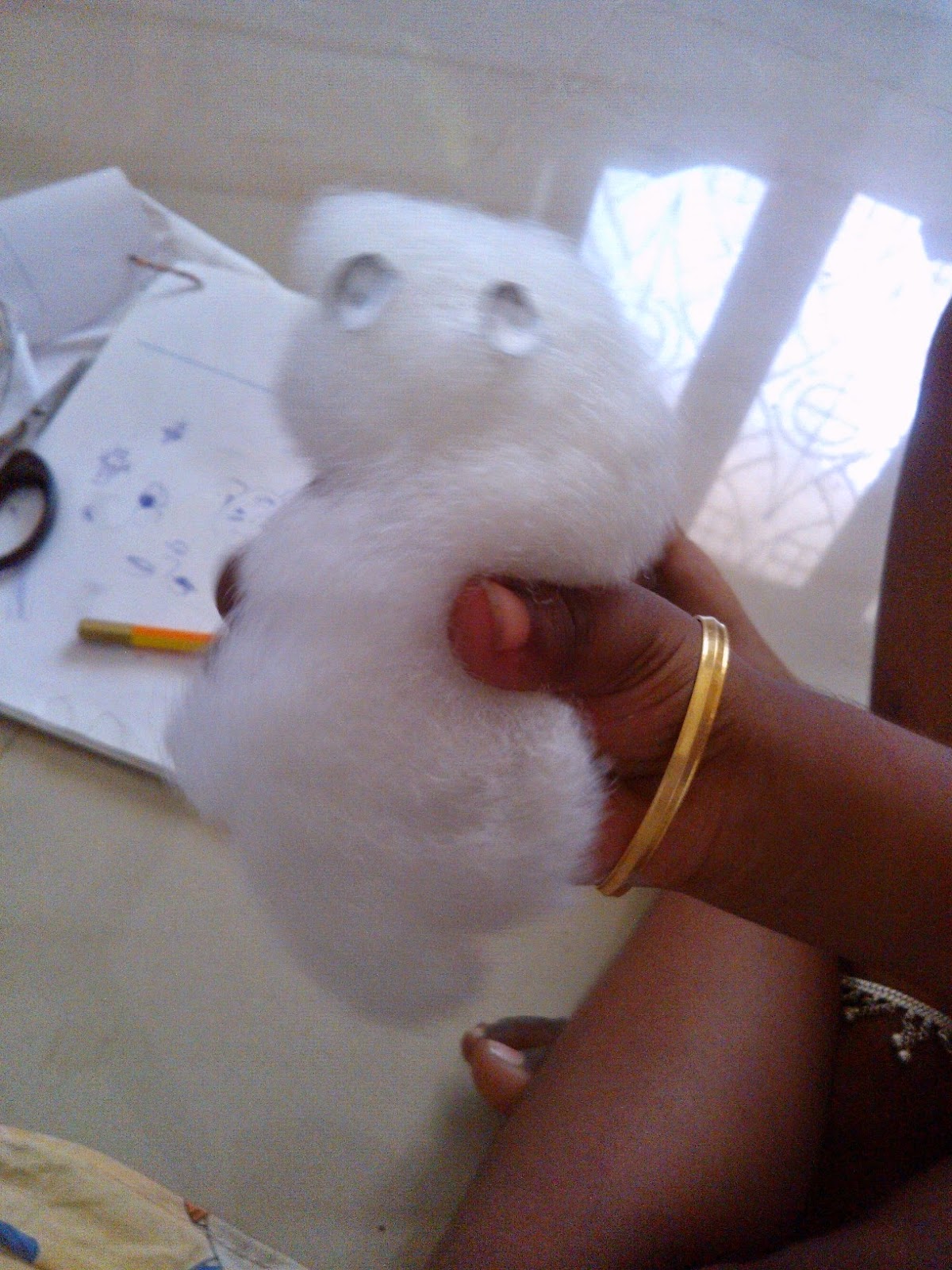
She also made this cotton chicken with my help.


Here is our paper little red hen. You can find the tutorial at krokotak.com


Science:

When we are reading the story, my little one asked what a mill is. So, i wanted to show her how a basic grist mill works.
First, we spend some time in our traditional stone mills.  We tried to make rice flour in our stone mill. 


My little one tried to rotate it.  She couldn't.  She found this from her wooden toy set and played with it.


 We also see how the mortar and pestle is used to grind the wet grains.
We watched these videos (video 1 , Video 2) which show how the same principle is used in the old flour mills.

Social Studies:

As Madhya Pradesh is the highest wheat producing state in India, we located the state in our India map.

Small World Play:

I thought of including a small world of farm animals as the sixth activity for my little one to play. Here is our small world of farm animals.  I wanted to put farm animals and foods what they eat. I put rice straws for cows, grass for goats and sheep , grass and horse gram for horses and some cereals for poultry.

My little one feed the horses with cereals i put for the poultry and started giving them bath.